
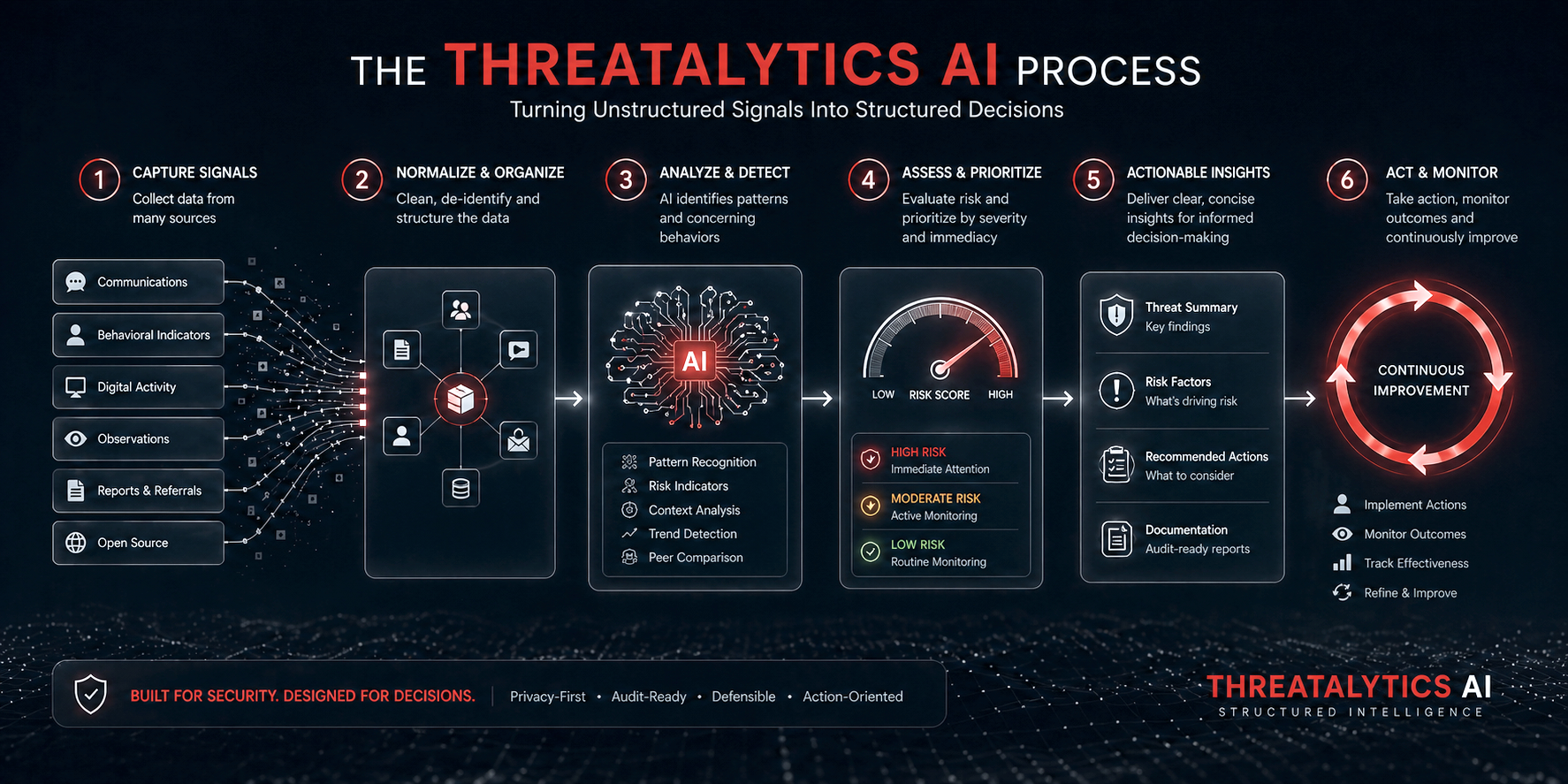
How it all works!
-

Platform — Built on Proven AI and Secure Cloud Infrastructure
Threatalytics AI is Structured Intelligence as a Service. This ensures enterprise-grade speed, scale, and uptime—whether you’re managing one case or a full caseload across districts or departments.
Unlike general-purpose AI tools, Threatalytics AI is tailored specifically to bring structure to your behavioral threat assessment process. It doesn’t predict—it guides. Built to reinforce best practices (like NTAC and SPJ), the platform acts as a logic layer that supports your team with behavioral scoring, documentation prompts, and role-based recommendations.
There’s no storage, and no PII risk. Threatalytics operates as a real-time assistant—flexible enough to adapt to any agency, yet secure enough to meet your compliance requirements.
-

Process — Supporting Your Team, Not Replacing It
Threatalytics AI is designed to enhance—not replace—professional judgment. It supports real-world teams by strengthening how you triage cases, document actions, and guide interventions.
Here’s how it works:
You enter known details—such as behaviors, grievances, or protective factors.
The AI responds with structured guidance—highlighting gaps, scoring threats, and prompting team collaboration.
As your team updates a case, Threatalytics adjusts in real time—ensuring each decision is defensible and documented.
This ecosystem helps prevent team fatigue, reduces bias, and keeps everyone aligned—even when pressure is high and time is short. It’s more than AI—it’s threat logic on demand.
-

Protection — Privacy-First, Audit-Ready, Field-Tested
Trust is built on transparency and safeguards. That’s why Threatalytics AI is configured for privacy-first operations from the start. It never stores user inputs or case data. All identifying information is auto-redacted.
Whether you're in K-12, higher ed, corporate, or healthcare environments, the platform meets the demands of multi-agency coordination and legal defensibility. It’s fully compatible with FERPA, HIPAA-relevant boundaries, and institutional policy.
You get the power of next-gen AI—without the risk of overreach.